
A conversation with DJ Forbes on rugby's values, team culture, and succesful athlete-coach relationships.
12 April 2026

Interview by Chris Mastaglio | ChildFund Rugby
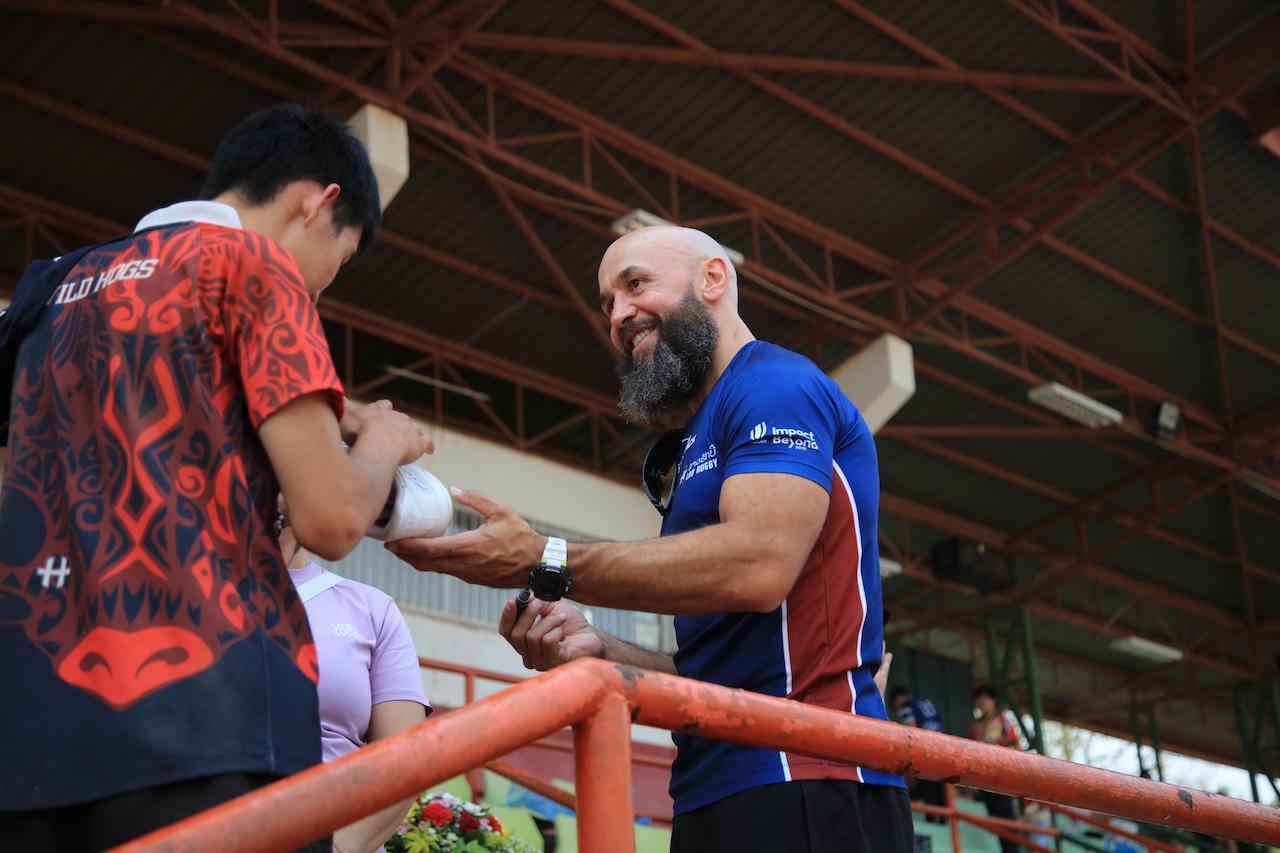
In March 2025, former New Zealand Sevens captain and World Rugby legend DJ Forbes visited Laos to see Pass It Back program in action. As a newly appointed ChildFund Rugby ambassador, DJ spent the week with Lao Rugby community coaches, players, and the Lao Rugby Federation to experience firsthand how the game is being used as a powerful tool for life skills development, leadership, and gender inclusion.
From community rugby sessions to national team training, DJ witnessed the full spectrum of the rugby journey - and reflected on what it takes to build strong systems, values-driven players, and sustainable pathways that keep young people in the game.
Introduction
Chris: I’m here today with New Zealand and World Rugby legend DJ Forbes. DJ, welcome. I’d love you to introduce yourself to the audience, particularly to those who might not be familiar with rugby.
DJ Forbes: Yeah, I’m DJ Forbes, former All Blacks Sevens player and recent ChildFund Rugby ambassador. I’m half Kiwi, half Samoan, born and raised in west Auckland, New Zealand. I’m excited about the opportunity to be involved with ChildFund Rugby and to leverage what I managed to do on the rugby field - chasing the ball around for a living.
Connecting youth to rugby pathways
Chris: This week, you’ve had the opportunity to visit the Lao Rugby Federation to see Pass It Back in action. Then you moved on to see the transition from youth rugby into adult rugby, with T1 Rugby being a key tool to support that. Finally, you got to take the field with their senior national 7s team. From your experience, particularly in New Zealand, what does that connection look like - bringing children into the game and providing a pathway so that they can aspire to play at the highest level?
DJ Forbes: It’s a tough one, especially with recent changes. I got a good appreciation being here and seeing things at the grassroots level. Back home, most kids grow up chucking the ball around in the backyard. A lot of them are expected to give rugby a crack from under-fives through to college. If you’re good enough, you might play first XV or prem sport and then get earmarked for bigger things.
In New Zealand, there’s a growing gap. Kids are identifying early that they don’t want to play - maybe due to the contact side of the game or their parents aren’t letting them. Tag or T1 options aren’t as prominent yet. With all the other sports available like basketball, netball, and football, it’s hard to know what’s going to work.
But being here and seeing what’s in place, it’s a great way to streamline and promote that transition. It’s interesting to see it firsthand.
New versions of the game
Chris: We’ve chatted this week about how historically Sevens was seen as a feeder to Fifteens - it wasn’t considered the “real” version of the sport. Obviously, that’s changed with Olympic inclusion. With T1 as a non-contact option for young people who may not want to go into contact rugby, do you think this adds to the game or detracts from it?
DJ Forbes: I think it’s adding to the game because it keeps boys and girls involved, throwing the ball around. With things like flag football being in the Olympics, there could be a pathway through tag or T1 for rugby.
You could start with T1, realise you’re actually a pretty good football player, and end up at the Olympics one day! It’s still about ball-handling, coordination, movement - all of that contributes across sports. It’s definitely not detracting, in my opinion.
Values and life skills
Chris: One of the things you’ll have seen this week is how rugby values are integrated into the Pass It Back curriculum through T1. From an athlete who’s played at the top level, where culture and values are key to team success, how much of that do you think is instilled at an early age?
DJ Forbes: Based on what I’ve seen in the past few days, having those values and skills highlighted at a young age is really key. It’s hard for young kids to absorb it all, but having that exposure early raises awareness.
When kids move up, they’ll know the culture will demand certain behaviours that help keep them at the elite level. For me, as a parent, I really appreciate when I send my kids to a local team where they’re taught that it’s not just about the game - it’s about confidence, courage, and trying new things.
When it’s embedded in the blueprint from a young age like what is happening here, it gives kids in low income countries a real head start.
Culture and team success
Chris: You talked about cultures and behaviours expected at the top level. What’s your perspective on what makes a successful team culture?
DJ Forbes: There’s no single winning formula, but a great culture demands standards and behaviours from the team. A lot of teams write values on the wall and say, “This is how we succeed,” but it doesn’t work like that. In the All Blacks Sevens, before you even get in, you know what’s expected. That’s the level you want.
We had to figure that out ourselves. The team I came into had legends like Rushy (Eric Rush) and Jonah Lomu, but we realised that culture didn’t fit us. We needed to build something new. It took a couple of years and some hard learnings, but we got there.
Coaching and generational change
Chris: You mentioned that buy-in is key. To get that buy-in, you need strong athlete-coach relationships. It’s something you’re passionate about, and it’s central to Pass It Back. What reflections do you have on what makes a coach great in building that relationship?
DJ Forbes: In Sevens, I really only had a couple of coaches, and Titch (Sir Gordon Tietjens) was one of them. He demanded high standards and lived them himself. He trained with us and led by example.
Over the years, I saw how generational shifts changed how you motivate people. As an inspirational coach now, I had to build my own philosophy: communication, leadership traits, and relationships.
It’s about being relatable and consistent. You can’t be yelling one day and quiet the next - athletes won’t know which version of you is showing up. And communication isn’t just talking - it’s listening, really hearing what’s being said.
Chris: Do you think coaches need different skills now to meet the expectations of younger generations?
DJ Forbes: A hundred percent. I’m a young Gen X, so I was used to being told what to do - no questions asked. But now, kids want to know how and why. Coaches have to adapt. If you’re stuck in your ways, that’s fine - but you might not reach the new generation as effectively.
Sport and commercial partnerships
Chris: Switching gears a bit - thinking about the commercial side of the game, especially post-COVID. Do you see a connection between the values and behaviours instilled in top athletes and commercial investment opportunities?
DJ Forbes: Yes, more companies now value leadership and culture in sport. The relationship has to work both ways - both sport and commercial partners need to leverage each other.
Athletes have to stop thinking it’s all about them. Commercial support plays a massive role. There are great opportunities now for companies that align with a team or athlete’s values and mission. That connection can take both parties to the next level.
Looking ahead
Chris: You’ve been in Laos for a few days now and are heading to the Hong Kong Sevens. What are your expectations for the tournament?
DJ Forbes: It’s been great to be here before heading to Hong Kong. It really grounded me. Hong Kong always has a special aura. There’s a new stadium, and while it’s hard to recreate the vibe of the old one, I didn’t want to miss the first one at the new Kai Tak Stadium.
As a fan now, I’m excited. I want to see the (New Zealand) boys bounce back - it’s been a tough start to the season, but they’ve done it before, so fingers crossed.
Chris: DJ, thank you so much - from all of us at ChildFund Rugby. Thanks for being an ambassador and for spending time with the Lao Rugby Federation. Best of luck in Hong Kong.
DJ Forbes: Thanks for having me.
Pass It Back is an integrated rugby and life skills curriculum that was started in Laos more than 10 years ago. It has been delivered in 15 countries to date, registering more than 85,000 players, and accrediting more than 3,000 Coaches. In Laos, the Lao Rugby Federation uses the curriculum as a core part of their Champa Ban youth rugby work.